


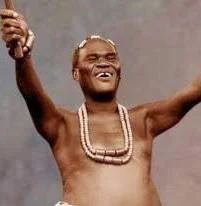
Chief Hubert Adedeji Ogunde was born on July 10, 1916, in Ososa, near Ijebu-Ode, Ogun State. From humble beginnings as a school teacher and church choirmaster, Ogunde rose to become Nigeria’s first professional theatre practitioner and a cultural icon whose works fused art with activism.
Theatre as a Weapon
In 1945, Ogunde founded the Ogunde Theatre Party, Nigeria’s first professional theatrical company. His plays, such as The Tiger’s Empire (1946) and Strike and Hunger (1946), boldly criticized colonial injustices and gave voice to ordinary Nigerians. This made him both loved by the masses and feared by colonial authorities.
Unlike the European-style theatre of his time, Ogunde’s productions blended traditional Yoruba folk music, dance, drumming, and drama, creating a distinctly Nigerian stage identity. His works became not only entertainment but also a weapon of cultural pride and political education.
Political Courage
Ogunde was fearless in his art. His 1945 play Strike and Hunger openly supported the Nigerian general strike, while later productions such as Bread and Bullet (1950) dramatized the 1949 Enugu coal miners’ massacre. His plays often brought him into conflict with colonial and later Nigerian governments, but Ogunde never wavered.
During the turbulent 1960s and 70s, Ogunde used his theatre to comment on politics, corruption, and injustice. His famous play Yoruba Ronu (“Yoruba, Think”) was so politically charged that it was banned in Western Nigeria in 1964.
Foundation of Nollywood and Yoruba Theatre
Beyond politics, Ogunde reshaped the cultural landscape of Nigeria. His traveling theatre troupes inspired later legends such as Moses Olaiya (Baba Sala), Ojo Ladipo, Adeyemi Afolayan (Ade Love), and eventually paved the way for the Yoruba film movement.
By experimenting with cinema in the 1970s and 80s (Aiye, Jaiyesimi, Aropin n’tenia), Ogunde linked live theatre to the screen, laying the groundwork for what would evolve into Nollywood — today one of the largest film industries in the world.
Famous Quotes from Ogunde
“Drama is not just to entertain, but to teach and awaken the people.”
“A true artist must be the conscience of his society.”
Legacy of a Cultural Giant
Ogunde’s influence on Nigerian arts is immeasurable. He trained and inspired generations of actors, musicians, and filmmakers, many of whom became the pioneers of Yoruba cinema. His life’s work helped define Nigerian performing arts and gave birth to the Nollywood industry that today commands global attention.
He passed away on April 4, 1990, but his plays, songs, and films continue to live on. In recognition of his contributions, he was awarded national honors and immortalized in Nigerian cultural history.
—
Legacy in Reflection
Chief Hubert Ogunde was more than an entertainer — he was a cultural warrior, a fearless dramatist, and the father of modern Nigerian theatre. His voice remains a reminder that art, when wielded with courage, can challenge oppression, inspire unity, and preserve identity.
Ogunde lives on — Gone But Not Forgotten.
Informdailynews






Leave a Reply